
Scope
Company
A $270B industry still running on paper.
Semi-custom homebuilding remains one of the least digitized industries despite billions in annual revenue. Sales teams juggle spreadsheets, PDF lot maps, tribal knowledge, anti-monotony restrictions, and disconnected systems—leading to delays, costly mistakes, frustrated buyers and ultimately resulting in millions of dollars in additional carrying costs for the builders.

Creating a modern platform, not another sales tool.
Despite billions of dollars flowing through new home construction every year, the semi-custom homebuilding process remains surprisingly manual. Developers define complex architectural restrictions, builders interpret those rules manually, and buyers navigate disconnected systems with little visibility into what they can actually build.
The result is an ecosystem heavily dependent on spreadsheets, PDFs, printed lot maps, institutional knowledge, and lengthy approval processes.
One particularly challenging problem is anti-monotony—the rules that prevent neighboring homes from looking too similar. These restrictions vary by community and influence which floor plans, elevations, color palettes, and exterior materials may be selected for every lot. Today, these decisions are still largely verified through manual pen-and-paper checks.
Three customers. Different problems. One shared platform.
One of the earliest product decisions was recognizing that WhiteRock wasn't solving for a single user. It needed to create value for three independent stakeholders with different incentives.
Developers
Builders
Accelerated sales funnel, less mistakes.
Builders and sales reps are able to confidently translate lot and finish availability in real time to buyers. This translates to more closing.
Customer problem solved:
Real-time information results in faster sales time and decreases costly change orders.
Buyers
A confident and interactive buying experience.
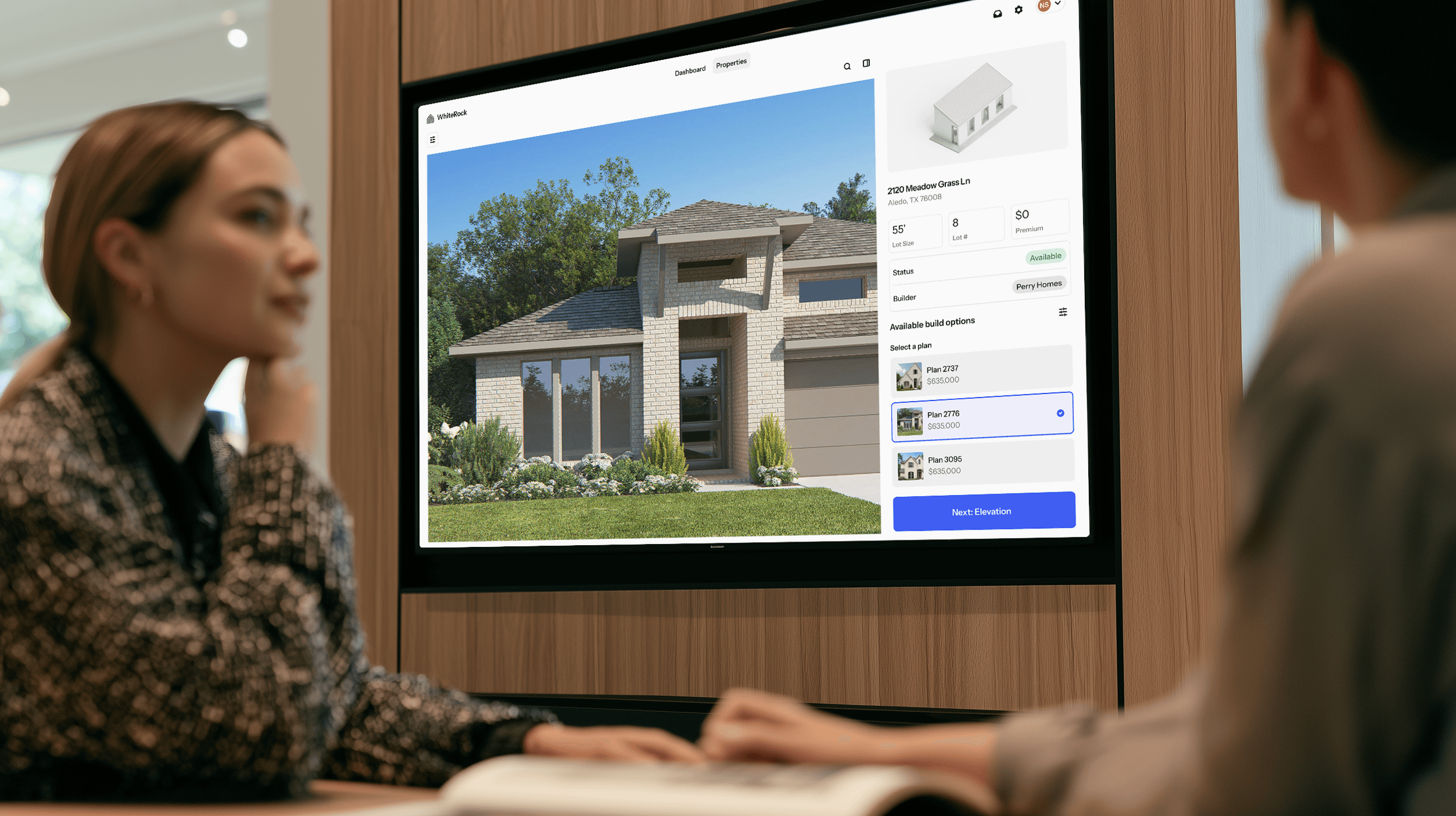
Buyers can choose their favorite lot, home or parameters and build their dream home with real-time information and accuracy.
Customer problem solved:
Buyers are informed, confident leading to faster contracts and better satisfaction ratings.
Build one platform—not three tools.
Rather than creating separate software for developers, builders, and buyers, I defined a platform strategy where each stakeholder contributed to and benefited from a shared source of truth.

04 / Core Foundation
Teaching the software how builders think.
The hardest problem wasn't displaying maps.
It was translating years of community planning rules and hundreds of pages of logic into software that could reason about every possible home placement or selection — then providing a way for builders and developers to manage these rules in an easy way.
Developers create a community, inventory and define the anti-monotony rules. Builders have access to real time availability and can confidently sell homes without costly mistakes. Buyers can make informed decisions, cutting time to contract in half and creating confident and happy buyers.


A Firm Foundation — Built to Scale.
No two semi-custom builders operate the same way. Every organization has its own communities, floor plans, architectural standards, pricing models, lot constraints, approval workflows, and sales processes. WhiteRock was designed from the ground up to adapt to those differences—not force builders into a one-size-fits-all system.
At its core, WhiteRock is a configurable intelligence platform. It unifies disconnected builder data into a single source of truth, then applies business rules, real-time inventory, AI-powered recommendations, and visualization across every customer interaction. Whether supporting a regional builder with a handful of communities or a national organization managing thousands of homesites, the platform scales through configuration rather than custom development.
By separating the underlying intelligence from the customer experience, builders can launch new communities faster, onboard new floor plans effortlessly, evolve pricing and incentives in real time, and continuously improve the buying journey without rebuilding the platform. As builders grow, WhiteRock grows with them—creating a foundation that becomes smarter, more connected, and more valuable over time.
06 / Impact
Delivering Value Across the Entire Homebuying Journey.
WhiteRock was designed to create measurable value for everyone involved in the semi-custom homebuying process. By connecting fragmented data, automating complex builder rules, and giving buyers confidence through real-time visualization, the platform streamlines operations, empowers sales teams, and delivers a more modern purchasing experience.
$2,000,000
Estimated annual savings per builder @ ~500 homes/year
30%
Less time fixing errors and creating change orders
40%
Faster sales cycle - anticipated impact to builder